


Highlander Press
The Diary of Connie Shakespear
The Diary of Connie Shakespear
A rare written and photographic record of Naga village life, colonial encounter, and Victorian travel in the Naga Hills between 1900 and 1902.
The Diary of Connie Shakespear: The Naga Hills 1900–1902 presents the travel diary of Connie Shakespear, who accompanied her husband, a Captain in the Naga Hills Military Police, through the Naga Hills district of Northeast India at the turn of the twentieth century.
Written between 1900 and 1902, the diary documents Naga villages, landscapes, customs, architecture, dress, graves, morungs, and everyday encounters, while also offering glimpses into British administrative life in Kohima, then a colonial outpost at the edge of the British Raj. The result is both a personal journal and an important archival source: a record of a world undergoing rapid historical change, seen through the eyes of an intrepid Victorian woman traveller.
Connie Shakespear’s perspective reflects the social position and assumptions of her time, yet she was also an unusually attentive observer. Her writing reveals curiosity, humour, sympathy, and a willingness to engage with the people and places around her. The diary is therefore valuable not because it escapes the colonial context, but because it allows modern readers to examine that context closely: its gaze, its limits, its encounters, and its unexpected moments of intimacy and mutual observation.
The volume is especially significant for its visual material. Connie’s sketches and photographs, produced in an era when handheld cameras were becoming newly available to amateurs, document Naga village architecture, grave forms, traditional clothing, landscapes, and social life. Together with the text, these images form a rare visual archive of the Naga Hills at the beginning of the twentieth century.
Why this book matters
This book matters because it preserves a primary source from a pivotal moment in the history of the Naga Hills. It offers scholars and general readers a window into village life, colonial administration, travel, gender, photography, and cross-cultural encounter at a time when Naga societies were being increasingly drawn into the political and administrative structures of empire.
Read critically, The Diary of Connie Shakespear is not only a record of Naga villages and landscapes, but also a self-portrait of a Victorian woman moving through a complex social world. It invites readers to consider how highland histories are preserved, mediated, and sometimes distorted through diaries, photographs, sketches, and colonial-era archives.
Critical praise
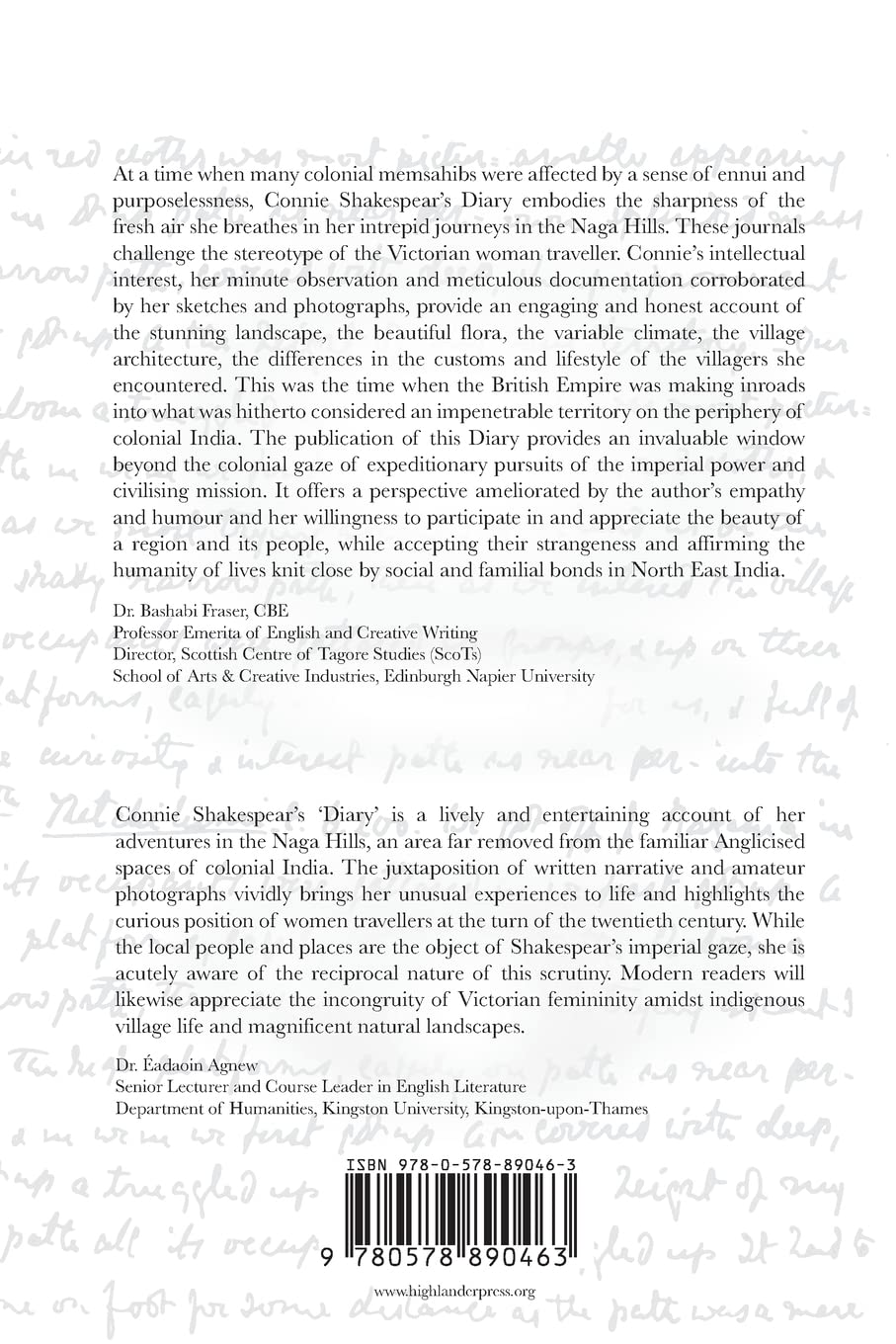
Dr Bashabi Fraser, CBE, of Edinburgh Napier University, describes the publication as providing an “invaluable window beyond the colonial gaze of expeditionary pursuits.”
Dr Eadaoin Agnew of Kingston University notes that modern readers will appreciate the striking presence of “Victorian femininity amidst indigenous village life and magnificent natural landscapes.”
Dr Temsurenla Ozukum of ICFAI University Nagaland writes that Connie Shakespear’s accounts give the impression of “an involved and sympathetic observer.”
Key themes
- Naga village life: The diary records village architecture, morungs, graves, dress, landscapes, and social encounters in the Naga Hills.
- Colonial encounter: The volume documents the interface between Naga communities and British administrative and military life in the early twentieth century.
- Victorian women’s travel writing: Connie Shakespear’s diary offers a rare example of a woman traveller observing, documenting, and reflecting on highland life in colonial Northeast India.
- Photography and visual archive: Her photographs and sketches provide important visual documentation from a period of profound historical transition.
- Kohima and the Naga Hills: The book offers insight into Kohima as a colonial administrative centre and into the surrounding villages and landscapes of the Naga Hills district.
- Memory, documentation, and representation: The diary invites critical reflection on how Indigenous societies were observed, described, photographed, and preserved in colonial-era archives.
Book details
- Author: Connie Shakespear
- Editor: Nigel Shakespear
- Full title: The Diary of Connie Shakespear: The Naga Hills 1900–1902
- Publisher: Highlander Press
- Edition: James Nigel Wyndham Shakespear edition
- Format: Paperback
- ISBN-10: 0578890461
- ISBN-13: 978-0578890463
- Publication date: June 1, 2023
- Print length: 236 pages
- Language: English
- Dimensions: 6.14 x 0.64 x 9.21 inches
- Item weight: 11.9 ounces
About the author
Connie Shakespear was a Victorian woman traveller whose diary records her journeys through the Naga Hills district of Northeast India between 1900 and 1902. She accompanied her husband, a Captain in the Naga Hills Military Police, and documented the landscapes, villages, architecture, dress, customs, and everyday encounters she observed during their travels.
As the wife of a soldier in the Indian Army, Connie wrote from within the social world of the British Empire, and her attitudes and assumptions should be read within that historical context. At the same time, her diary shows an unusual degree of curiosity, close observation, and engagement with the Naga people among whom she travelled. Her writing is marked by an interest in village life, social custom, material culture, and the experience of moving through a region then situated at the frontier of British colonial administration.
Connie Shakespear’s photographs and sketches are an especially important part of the volume. Made during a period when handheld cameras were becoming available to amateur photographers, they preserve visual details of Naga morungs, graves, villagers in traditional clothing, settlements, and landscapes. Connie Shakespear died in 1914.
About the editor
Nigel Shakespear is the editor of this edition of The Diary of Connie Shakespear. His editorial work brings together Connie Shakespear’s text, sketches, and photographs, making available an important primary source for readers interested in the Naga Hills, colonial Northeast India, Victorian travel, anthropology, history, and early photography.
An Englishman abroad for much of his life, Nigel Shakespear has lived and worked across Eastern Europe, including Romania and Russia. His experience of Eastern Europe began during the Cold War, when he served in the British Army, and he later worked on European Union-funded programmes in the region. From 2003 he spent much of a decade in Romania, travelling widely and working with government initiatives aimed at improving conditions for Roma communities.
His long-standing interest in travel, social observation, historical context, and cross-cultural encounter informs his work as editor of this diary, where he helps present Connie Shakespear’s record as both a lively travel narrative and a valuable historical document.
Ideal for
This book is ideal for anthropologists, historians, scholars of photography, students of colonial and postcolonial studies, researchers of Northeast India, readers of women’s travel writing, and anyone interested in the history, culture, and visual documentation of the Naga Hills.
Subject areas
- Naga Hills history
- Northeast India
- Colonial and postcolonial studies
- Anthropology and ethnographic archives
- Victorian women’s travel writing
- Photography and visual history
- Kohima and the British Raj
- Naga village life and material culture
- Diaries, memoirs, and primary sources
- Highland Asia
For courses and libraries
The Diary of Connie Shakespear is well suited for courses in anthropology, history, visual anthropology, colonial and postcolonial studies, South Asian studies, gender and travel writing, archival studies, and the history of photography. Its combination of diary text, sketches, and photographs makes it especially valuable for research libraries, teaching collections, and readers interested in primary sources from the Naga Hills and colonial Northeast India.
Suggested citation
Shakespear, Connie. The Diary of Connie Shakespear: The Naga Hills 1900–1902. Edited by Nigel Shakespear. Highlander Press, 2023.
Share

Printed on demand and shipped by our distributor.