


Highlander Press
Nagas in the 21st Century
Nagas in the 21st Century
A contemporary anthology on Naga society, identity, politics, religion, memory, and social change in the postcolonial period.
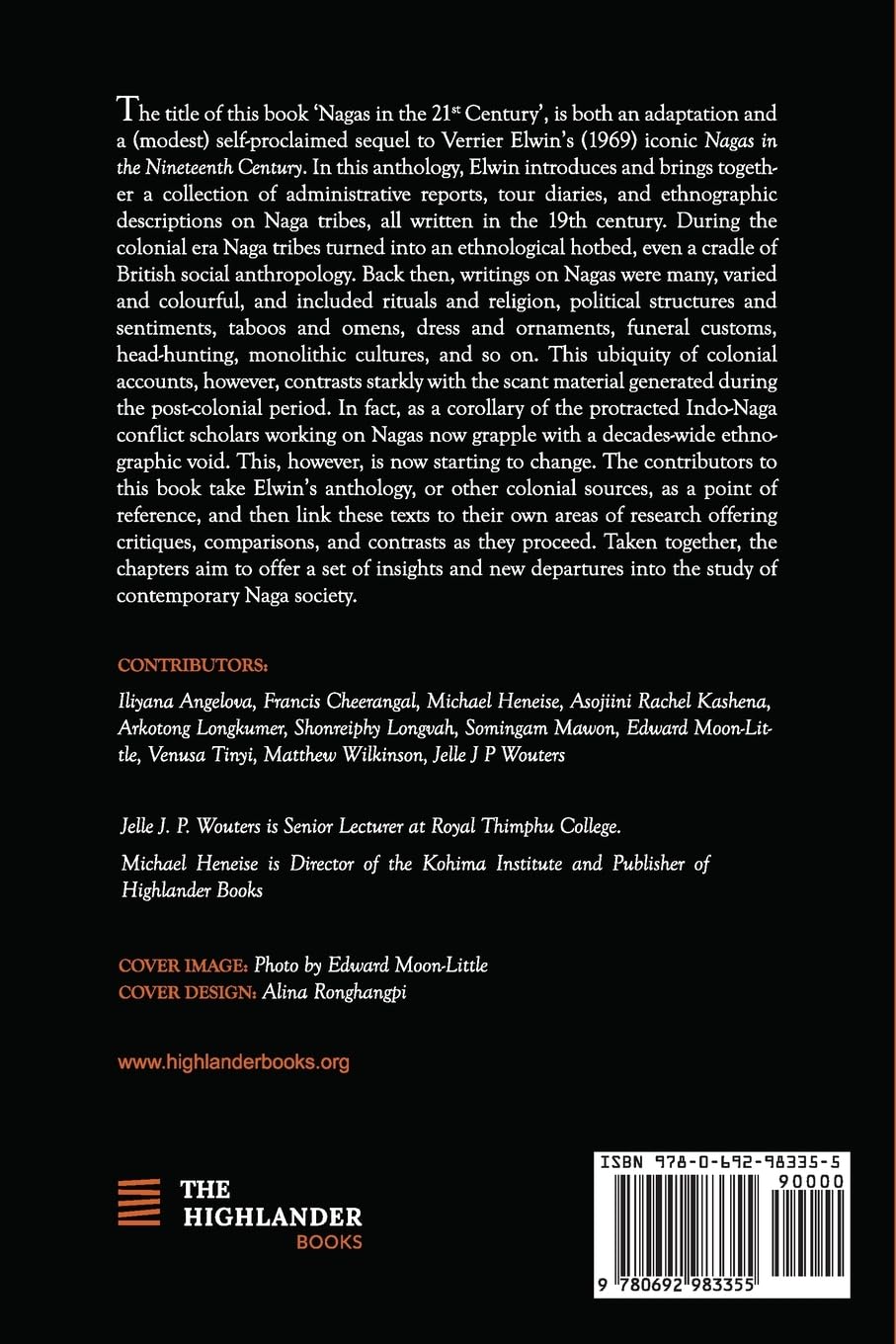
Nagas in the 21st Century is both an adaptation of and a modest sequel to Verrier Elwin’s landmark anthology Nagas in the Nineteenth Century. While Elwin’s volume brought together colonial-era administrative reports, tour diaries, and ethnographic descriptions of Naga communities, this book turns attention to the contemporary period, asking how Naga societies may be understood after decades of political conflict, social transformation, Christian conversion, and postcolonial change.
During the colonial era, the Naga Hills became an important site for ethnological writing and early British social anthropology. Accounts of Naga societies were abundant and often colourful, addressing rituals and religion, political structures, omens and taboos, dress and ornamentation, funeral customs, head-hunting, village life, and monolithic cultures. Yet this abundance of colonial documentation contrasts sharply with the relative scarcity of postcolonial scholarship on Naga communities, a gap shaped in part by the protracted Indo-Naga conflict and the difficulties it created for sustained ethnographic research.
The contributors to this volume take Elwin’s anthology and other colonial sources as points of departure, but they do not simply revisit the archive. Instead, they place earlier writings into dialogue with contemporary research, offering critique, comparison, reinterpretation, and ethnographic renewal. The result is a collection that addresses Naga identity, the village republic, changing forms of traditional governance, dreams, Christian conversion, the Hornbill Festival, memories of head-hunting, Naga nationalist politics, festival continuity and change, and post-conflict society.
More than a retrospective study, Nagas in the 21st Century offers a set of new departures for the study of contemporary Naga life. It asks what becomes visible when colonial ethnographic categories are read against present-day social realities, and how Naga communities continue to negotiate identity, memory, sovereignty, religion, and political belonging in the twenty-first century.
Why this book matters
This book matters because it reopens the study of Naga society in contemporary terms. For much of the twentieth century, scholarly work on the Nagas remained heavily dependent on colonial archives, while postcolonial ethnographic engagement was constrained by political conflict and restricted access. This volume helps address that ethnographic void by bringing together new research on Naga social, political, religious, and cultural life.
For readers interested in Northeast India, Highland Asia, Indigenous politics, Christianity, nationalism, village governance, memory, and the afterlives of colonial anthropology, Nagas in the 21st Century offers an important contribution to understanding how Naga societies have been represented, transformed, and reinterpreted across time.
Key themes
- Contemporary Naga society: The volume examines social, political, religious, and cultural change among Naga communities in the twenty-first century.
- Colonial archives and postcolonial critique: Contributors place colonial writings in dialogue with contemporary ethnographic and historical research.
- Identity and belonging: The essays explore how Naga identities are formed, contested, remembered, and rearticulated in changing political contexts.
- Village governance and political life: The book considers the Naga village republic, traditional governance, nationalist politics, and post-conflict society.
- Religion, dreams, and cultural transformation: Chapters address Christian conversion, dreams, festivals, ritual memory, and changing moral worlds.
- Memory and historical consciousness: The volume asks how the past is remembered, represented, and reworked in contemporary Naga life.
Book details
- Editors: Jelle J. P. Wouters and Michael T. Heneise
- Full title: Nagas in the 21st Century
- Publisher: Highlander Press
- Format: Paperback
- ISBN-10: 069298335X
- ISBN-13: 978-0692983355
- Publication date: October 2, 2023
- Print length: 258 pages
- Language: English
- Dimensions: 6.14 x 0.7 x 9.21 inches
- Item weight: 12.9 ounces
About the editors
Jelle J. P. Wouters is a social anthropologist who has carried out long-term ethnographic and historical research among upland and tribal Naga communities in India’s Northeast. His work has addressed insurgency, violence, vernacular politics, capitalism, resource extraction, social history, and the political anthropology of Highland Asia.
His current research focuses on environmental humanities, climate change, water, and human-animal-plant entanglements in Bhutan and Highland Asia more widely. He teaches at Royal Thimphu College in Bhutan in the Department of Social Science and serves as Chair of the Himalayan Centre for Environmental Humanities in Thimphu. He holds an MPhil with Distinction in Social Anthropology from the University of Oxford and completed his Ph.D. in Anthropology at North-Eastern Hill University in Shillong, India. Before joining Royal Thimphu College, he taught at Sikkim Central University, where he was asked to establish the Anthropology Department, and was a visiting fellow at Eberhard Karls University on a “Teaching for Excellence” award granted by the German Research Foundation.
Michael T. Heneise is an American anthropologist and Associate Professor in the Department of Archaeology, History, and Religious Studies at UiT The Arctic University of Norway. He has conducted fieldwork across South America, South Asia, and the Himalayas, and his doctoral research at the University of Edinburgh examined dreams and political agency in the Indo-Myanmar borderlands.
Prior to Edinburgh, he studied anthropology at the Latin American Faculty of Social Sciences in Quito, Ecuador. He is the founder and Editor-in-Chief of Highlander Press; co-founder and former executive director of the Highland Institute, Nagaland; and co-editor of HIMALAYA, the Journal of the Association for Nepal and Himalayan Studies. His research interests include the anthropology of dreams, Indigenous knowledge systems, Naga cosmology, religion and ecology, medical pluralism, and Highland Asia.
Ideal for
This book is ideal for anthropologists, historians, political scientists, scholars of religion, students of Northeast India, researchers of Indigenous politics, and readers interested in contemporary Naga society, postcolonial anthropology, Christianity, nationalism, memory, and Highland Asia.
Subject areas
- Naga society and culture
- Northeast India
- Highland Asia
- Political anthropology
- Colonial and postcolonial ethnography
- Indigenous politics and nationalism
- Christian conversion and religious change
- Dreams, memory, and cosmology
- Village governance and traditional institutions
- Festival, identity, and cultural transformation
For courses and libraries
Nagas in the 21st Century is well suited for courses in anthropology, history, Indigenous studies, South Asian studies, religious studies, political anthropology, postcolonial studies, and the study of Northeast India. Its combination of historical reflection, contemporary ethnography, and thematic breadth makes it especially useful for university teaching, graduate seminars, research libraries, and collections focused on Highland Asia and Indigenous societies.
Suggested citation
Wouters, Jelle J. P., and Michael T. Heneise, eds. Nagas in the 21st Century. Highlander Press, 2023.
```
Share

Printed on demand and shipped by our distributor.