


Highlander Press
Nagas as a Society Against Voting
Nagas as a Society Against Voting
A collection of eleven essays on Naga political life, democracy, identity, kinship, insurgency, and the social imagination of Highland Asia.
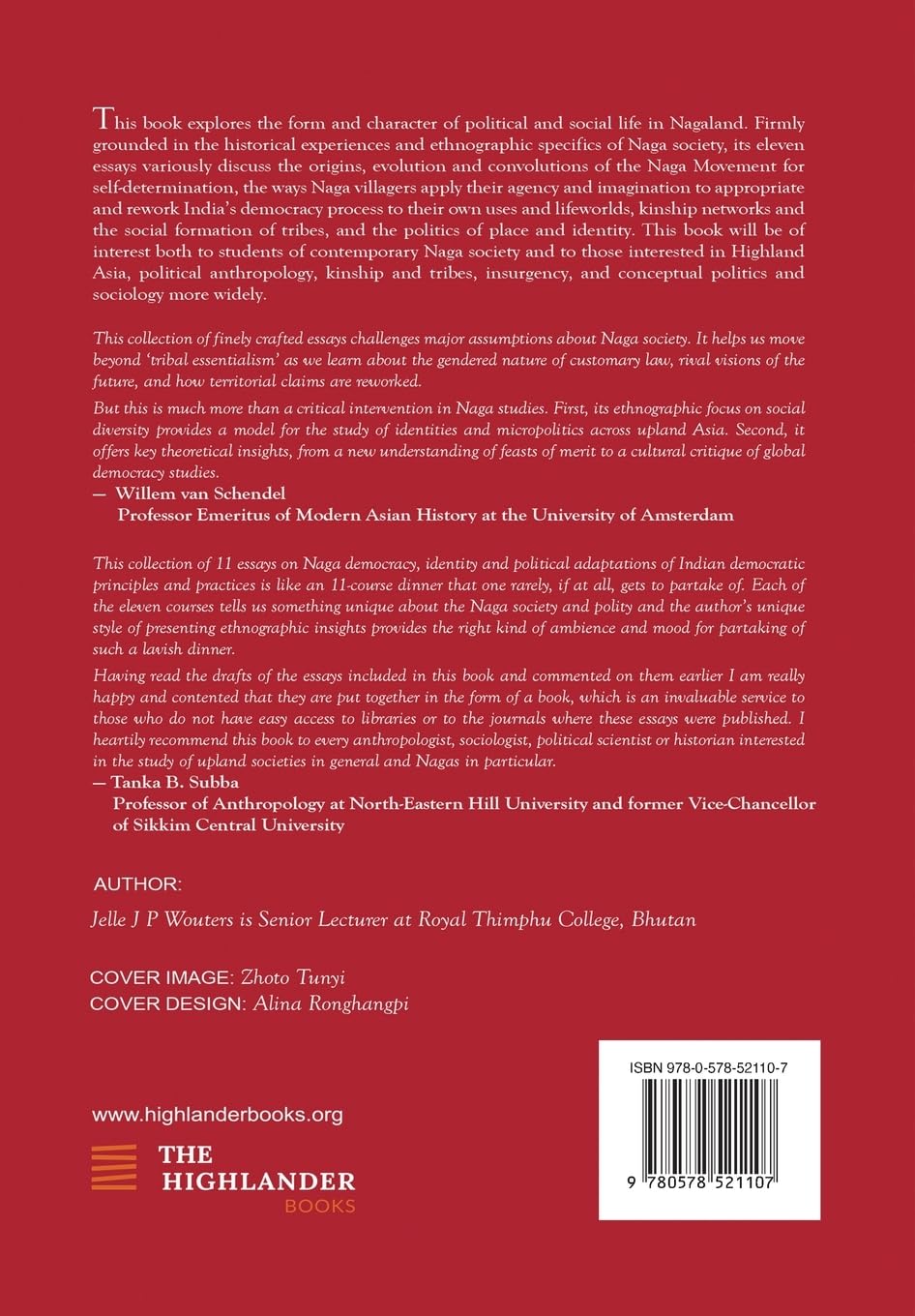
Nagas as a Society against Voting: And Other Essays explores the form and character of political and social life in Nagaland. Firmly grounded in the historical experiences and ethnographic specifics of Naga society, this collection brings together eleven essays on the Naga Movement for self-determination, democratic practice, village life, kinship networks, tribal formation, place-making, identity, and political imagination.
The book’s provocative title points to a central anthropological question: what happens when the formal procedures of electoral democracy encounter social worlds shaped by village deliberation, kinship obligations, customary institutions, tribal affiliations, and historical struggles for sovereignty? Rather than treating democracy as a universal model that is simply adopted or rejected, Jelle J. P. Wouters examines how Naga communities appropriate, reinterpret, resist, and rework democratic processes according to their own histories, lifeworlds, and political aspirations.
The essays address the origins, evolution, and complexities of the Naga political struggle, showing how local political culture and everyday behaviour shape the broader Naga political fabric. They also examine kinship and tribe, the politics of place and identity, rival visions of the future, gendered aspects of customary law, and the ways territorial claims are made, debated, and reworked.
More than a study of electoral politics, Nagas as a Society against Voting is a sustained contribution to political anthropology, Naga studies, and the study of upland societies. It shows how concepts such as democracy, tribe, custom, identity, sovereignty, and citizenship take on distinctive meanings when viewed from the lived political worlds of Nagaland.
Why this book matters
This book matters because it challenges major assumptions about Naga society and about democracy itself. It moves beyond simplified accounts of “tribal” politics by showing the social diversity, historical depth, and conceptual sophistication of Naga political life.
For readers interested in Northeast India, Highland Asia, political anthropology, Indigenous politics, kinship, insurgency, and the cultural critique of global democracy studies, Nagas as a Society against Voting offers an important and theoretically generative account of how people make political worlds from within the constraints and possibilities of history.
Critical praise
Willem van Schendel, Professor Emeritus of Modern Asian History at the University of Amsterdam, describes the collection as a set of finely crafted essays that challenge major assumptions about Naga society. He notes that the book helps readers move beyond “tribal essentialism” through its attention to customary law, competing futures, territorial claims, and the micropolitics of upland Asia.
Niketu Iralu, Naga elder, peace activist, and proponent of human rights and non-violence, praises the scholarly care of Wouters’s investigation and the book’s contribution to understanding the Naga question. He emphasizes the importance of independent scholarship in clarifying local political culture, historical memory, and the broader Naga political struggle.
Tanka B. Subba, Professor of Anthropology at North-Eastern Hill University and former Vice-Chancellor of Sikkim Central University, warmly recommends the volume to anthropologists, sociologists, political scientists, and historians interested in upland societies and the Nagas in particular. He describes the eleven essays as offering distinct and richly textured insights into Naga society and polity.
Key themes
- Naga political life: The essays examine the social, historical, and cultural foundations of politics in Nagaland.
- Democracy and voting: The book asks how Naga villagers appropriate, reinterpret, and rework Indian democratic practices within their own political lifeworlds.
- The Naga Movement: Several essays address the origins, evolution, and complexities of the Naga struggle for self-determination.
- Kinship, tribe, and social formation: The volume explores how kinship networks, tribal affiliations, and social relations shape political practice and identity.
- Customary law and gender: The book engages questions of customary authority, social hierarchy, gendered exclusion, and competing interpretations of tradition.
- Place, territory, and identity: Essays consider how place, belonging, territorial claims, and historical consciousness are central to Naga political imagination.
- Conceptual politics: The collection contributes to broader debates about democracy, sovereignty, indigeneity, tribal society, and political theory from the perspective of Highland Asia.
Book details
- Author: Jelle J. P. Wouters
- Full title: Nagas as a Society against Voting: And Other Essays
- Publisher: Highlander Press
- Format: Paperback
- ISBN-10: 0578521105
- ISBN-13: 978-0578521107
- Publication date: December 1, 2023
- Print length: 276 pages
- Language: English
- Dimensions: 6.69 x 0.75 x 9.61 inches
- Item weight: 15.7 ounces
About the author
Jelle J. P. Wouters is a social anthropologist who has carried out long-term ethnographic and historical research among upland and tribal Naga communities in India’s Northeast. His work has addressed insurgency, violence, vernacular politics, capitalism, resource extraction, social history, kinship, tribal formation, and the political anthropology of Highland Asia.
His scholarship is especially concerned with how political life is shaped through local histories, social institutions, everyday practices, and the conceptual worlds of the people who inhabit them. In his work on Nagaland, Wouters examines the Naga political struggle, village democracy, customary authority, identity formation, and the ways democratic processes are appropriated, resisted, and reimagined in upland social worlds.
His current research focuses on environmental humanities, climate change, water, and human-animal-plant entanglements in Bhutan and Highland Asia more widely. He teaches in Bhutan in the Department of Social Science and serves as Chair of the Himalayan Centre for Environmental Humanities in Thimphu.
Wouters holds an MPhil with Distinction in Social Anthropology from the University of Oxford and completed his Ph.D. in Anthropology at North-Eastern Hill University in Shillong, India. Before joining Royal Thimphu College, he taught at Sikkim Central University, where he was asked to establish the Anthropology Department, and was a visiting fellow at Eberhard Karls University on a “Teaching for Excellence” award granted by the German Research Foundation.
Ideal for
This book is ideal for anthropologists, sociologists, political scientists, historians, scholars of Indigenous politics, students of Northeast India, researchers of Highland Asia, and readers interested in democracy, kinship, tribal formation, insurgency, identity, and political life in upland societies.
Subject areas
- Naga society and politics
- Northeast India
- Highland Asia
- Political anthropology
- Democracy and voting
- Indigenous politics
- Kinship and tribe
- Customary law and gender
- Insurgency and self-determination
- Vernacular politics
- Territory, place, and identity
- Conceptual politics and social theory
For courses and libraries
Nagas as a Society against Voting is well suited for courses in anthropology, political science, sociology, Indigenous studies, South Asian studies, history, postcolonial studies, and the study of democracy beyond formal institutions. Its ethnographic depth, theoretical reach, and focus on Naga political life make it especially valuable for university teaching, graduate seminars, research libraries, and collections focused on Northeast India, Highland Asia, and upland societies.
Suggested citation
Wouters, Jelle J. P. Nagas as a Society against Voting: And Other Essays. Highlander Press, 2023.
Share

Printed on demand and shipped by our distributor.