


Highlander Press
Democracy in Nagaland
Democracy in Nagaland
An interdisciplinary study of democratic politics, elections, tribal institutions, gender debates, and political life in Nagaland.
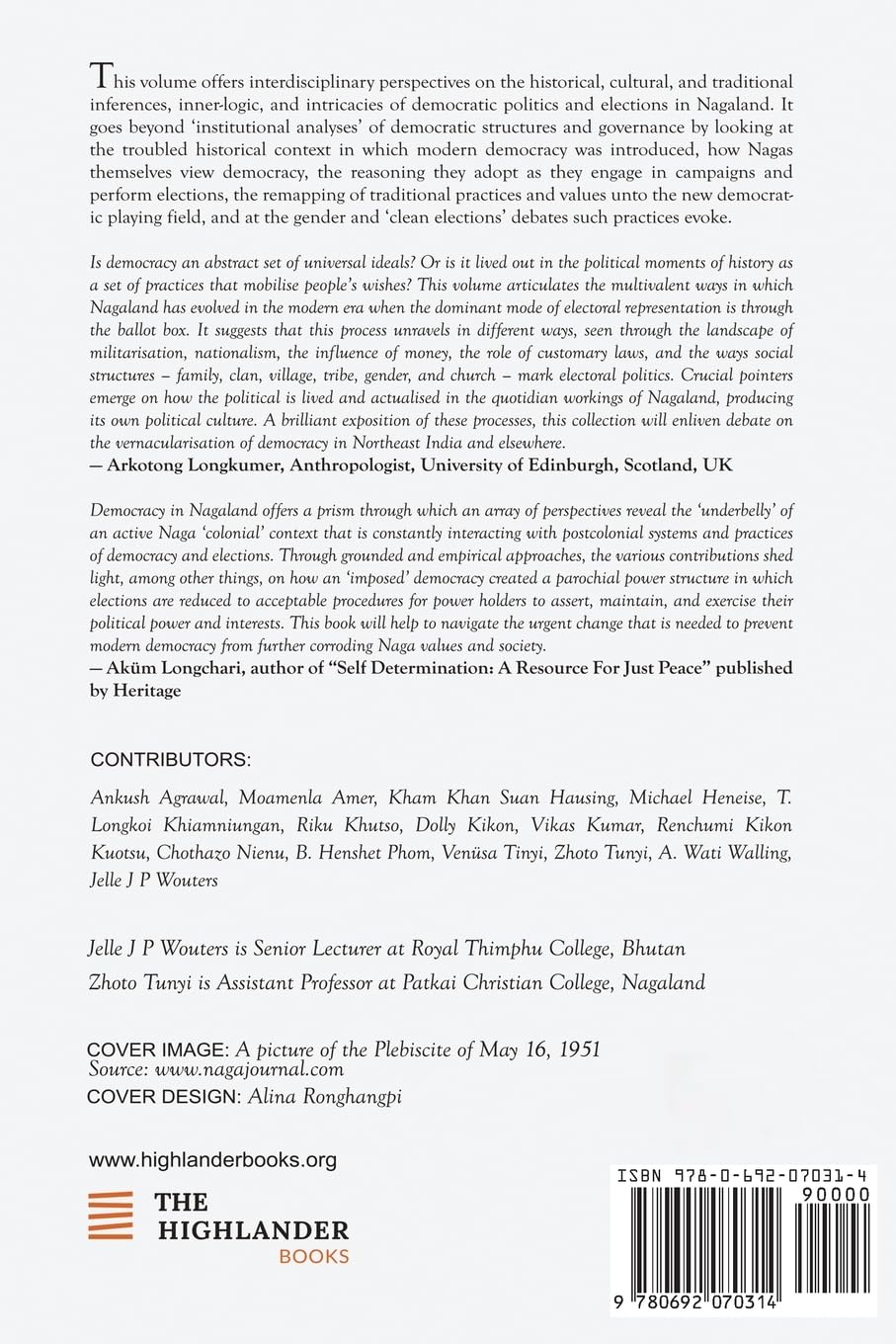
Democracy in Nagaland: Tribes, Traditions, Tensions offers interdisciplinary perspectives on the historical, cultural, and traditional logics that shape democratic politics and elections in Nagaland. Rather than treating democracy only as a formal institutional system, this volume asks how democratic practice is interpreted, performed, contested, and reworked within Naga social worlds.
The book examines the troubled historical context in which modern electoral democracy was introduced, the ways Nagas themselves understand and evaluate democratic practice, and the reasoning communities adopt as they engage in campaigns, voting, public debate, and political negotiation. It moves beyond conventional institutional analysis by attending to the everyday moral, social, and cultural textures of democratic life.
Central to the volume is the question of how older practices and values are remapped onto the democratic playing field. Naga village institutions, tribal affiliations, traditions of public deliberation, consensus-seeking, gendered exclusions, and community obligations all interact with the formal procedures of electoral politics. Democracy, in this setting, is not simply imported or implemented; it is translated, appropriated, challenged, and lived through local histories and social formations.
The volume also addresses the tensions generated by democratic participation, including debates around gender, women’s political representation, corruption, electoral morality, and “clean elections.” By placing elections within the broader social and historical landscape of Nagaland, Democracy in Nagaland opens a critical conversation about Indigenous politics, postcolonial state formation, militarization, and the complex meanings of democratic life.
Why this book matters
This book matters because it challenges the idea that democracy is a single, uniform system that societies simply possess more or less fully. Instead, it shows that democracy takes shape through local histories, cultural idioms, institutional inheritances, social tensions, and political struggles.
For readers interested in Northeast India, Indigenous politics, electoral democracy, gender, village governance, tribal institutions, and postcolonial political life, Democracy in Nagaland offers an important account of how democratic forms are debated, adapted, and contested in a region marked by deep historical complexity and political violence.
Critical praise
Bengt G. Karlsson, Professor in the Department of Anthropology at Stockholm University, describes Democracy in Nagaland as a powerful contribution that encourages readers to think of democracy as something mediated through local histories, social complexities, and cultural idioms.
Karlsson notes that the book invites engagement with the paradoxes of democratic life in Nagaland: how democratic forms may reproduce existing power structures, while also becoming tools through which those very structures are questioned.
He further observes that the volume opens “a new conversation about contemporary indigenous politics,” moving beyond stereotypical depictions that either romanticize or condemn tribal societies.
Key themes
- Democracy from below: The volume studies democratic life through campaigns, elections, public deliberation, village institutions, and everyday political reasoning.
- Tribes, traditions, and tensions: The book examines how tribal affiliations, inherited practices, and community values interact with modern electoral politics.
- Naga village governance: Contributors consider traditions of village deliberation, consensus-making, authority, and the limits of participation.
- Gender and representation: The volume addresses women’s political participation, exclusion from traditional institutions, and debates over gender justice in democratic life.
- Clean elections and political morality: The book explores reform movements, corruption debates, electoral ethics, and the moral language of democratic accountability.
- Postcolonial state formation: The essays situate democracy in relation to the violent postcolonial experience of the Nagas, militarization, nationalism, and the Indian state.
Book details
- Editors: Jelle J. P. Wouters and Zhoto Tunyi
- Full title: Democracy in Nagaland: Tribes, Traditions, Tensions
- Publisher: Highlander Press
- Format: Paperback
- ISBN-10: 0692070311
- ISBN-13: 978-0692070314
- Publication date: December 15, 2023
- Print length: 306 pages
- Language: English
- Dimensions: 6.14 x 0.83 x 9.21 inches
- Item weight: 15.2 ounces
About the editors
Jelle J. P. Wouters is a social anthropologist who has carried out long-term ethnographic and historical research among upland and tribal Naga communities in India’s Northeast. His work has addressed insurgency, violence, vernacular politics, capitalism, resource extraction, social history, and the political anthropology of Highland Asia.
His current research focuses on environmental humanities, climate change, water, and human-animal-plant entanglements in Bhutan and Highland Asia more widely. He teaches in Bhutan in the Department of Social Sciences and serves as Chair of the Himalayan Centre for Environmental Humanities in Thimphu. He holds an MPhil with Distinction in Social Anthropology from the University of Oxford and completed his Ph.D. in Anthropology at North-Eastern Hill University in Shillong, India.
Before joining Royal Thimphu College, he taught at Sikkim Central University, where he was asked to establish the Anthropology Department, and was a visiting fellow at Eberhard Karls University on a “Teaching for Excellence” award granted by the German Research Foundation.
Zhoto Tunyi is Assistant Professor at Patkai Christian College. His work and editorial contribution to this volume are situated within the study of Naga society, democratic life, community institutions, and the complex relationship between tradition, political participation, and social change in Nagaland.
Together, the editors bring anthropological, historical, and regionally grounded perspectives to the study of democratic practice in Nagaland, foregrounding the ways electoral politics are embedded in local institutions, moral debates, tribal affiliations, gendered exclusions, and the broader postcolonial experience of the Nagas.
Ideal for
This book is ideal for anthropologists, political scientists, historians, scholars of Indigenous politics, students of Northeast India, researchers of electoral democracy, and readers interested in the relationship between tribal institutions, democratic participation, gender, nationalism, and postcolonial state formation.
Subject areas
- Democracy in Nagaland
- Northeast India
- Political anthropology
- Indigenous politics
- Electoral democracy
- Village governance and traditional institutions
- Gender and political representation
- Clean elections and political reform
- Postcolonial state formation
- Naga society and culture
- Tribal politics and public deliberation
- Highland Asia
For courses and libraries
Democracy in Nagaland is well suited for courses in anthropology, political science, Indigenous studies, South Asian studies, history, gender studies, postcolonial studies, and the study of democracy beyond Euro-American institutional models. Its interdisciplinary approach makes it especially useful for university teaching, graduate seminars, research libraries, and collections focused on Northeast India, Indigenous politics, and democratic practice in complex social worlds.
Suggested citation
Wouters, Jelle J. P., and Zhoto Tunyi, eds. Democracy in Nagaland: Tribes, Traditions, Tensions. Highlander Press, 2023.
Share

Printed on demand and shipped by our distributor.